
In the first two parts we have seen the date and content of the different Śulbasūtras and glimpse of some of the basic and important constructions given in them. For different purposes different shapes of the Vedis are prescribed. When different shapes needed to be of the same area the seers transform one shape into the other of the same area.
Transformation of one figure to the other of equal area
An important feature is converting one figure into another shape of equal area namely circling the square, squaring the circle, a square equal to sum of two squares, a square equivalent to a triangle, an isoscles trapezium equal to a given rectangle or square, a square equivalent to a rhombus and so on. These constructions reveal their sound knowledge about the geometry of plane and solid figures. Śulbasūtras prescribe a lot of rules for transformation. While doing so several mathematical results such as the value of p (pi) etc. are obtained. Two of them are presented here.
- a) Transforming a square into a rectangle of equal area:
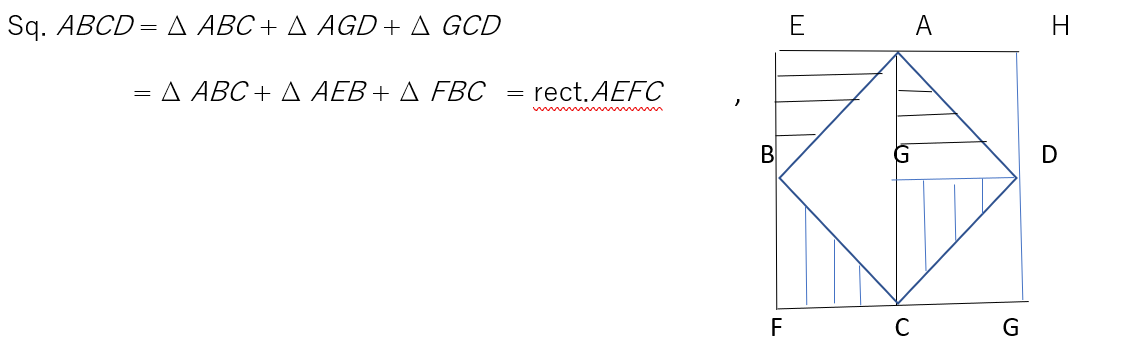
Baudhāyana Śulbasūtra (BŚ.s2.3-2.4) gives a rule for transforming a square into a rectangle having the same area:
समचतुरश्रं दीर्घचतुरस्त्रं चिकीर्षन् अस्तदक्ष्ण्यापच्छिद्य भागं द्वेधा विभज्य पार्श्वयोरुपदध्याद्यथापयोग्यम् ।।
‘A square intended to be transformed into a rectangle is cut off by its diagonal. One portion is divided into two equal parts which are placed on the two sides of the other portion so as to fit them exactly.’
The square is transformed into a rectangle such that the diagonal of the square equals the longer side of the rectangle. The square ABCD is divided by its diagonal AC. The portion ADC is again divided into two equal halves by GD and each is transferred to occupy the position AEB and BFC. The figure AEFC is the required rectangle.
Transforming a square into a circle of equal area:
Here for example one such construction of drawing a circle equal in area to a square given in Mānava śulbasūtra (11.15) is explained:
चतुरस्रं नवधा कुर्याद् धनुः कोट्यास्त्रिधात्रिधा ।
उत्सेधात्पाममंलुम्पेत्पुरीषेणेह तावत् समम् ॥
“Divide the square in to nine parts by drawing three (parallel) lines from two sides; drop out the fifth portion (in the centre) and fill it up with loose earth”.
The elongated trisecting lines will divide the arcual segments of the circumscribing circle into three parts each. Let OH in figure be the radius of the circum-circle of the square ABCD (to be converted in to an equal circle). One-fifth of the height (utsedha) OH = HK. Now OK = OH −HK = four fifth of OH . Now a circle having OK as radius will be the required circle, having area equal to the area of the given square.
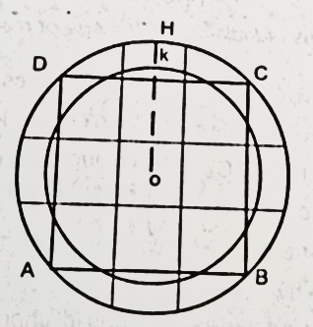
Let s and r be the side of given square and radius of equal circle constructed respectively. Now, r = OK = (4/5) OH = (4/5) OD = .
By construction, pr 2 = s2. Hence the implied approximation is found to be p()2 = s2 i.e. p = 25/8 = 3.125.
Constructions of citis.(Fire-altars)
Each citi is utilized for a specific purpose
| Name of citi | Shape | Desired Objective |
| Prauga citi | Isosceles triangle | For nullifying an enemy attack |
| Ubhayata-Prauga | Rhombus | For warding off an enemy attack |
| Ratha cakra | Circle | For victory over the enemy |
| Paricayya | Concentric circles | For acquiring land |
| Droṇa | ’Trough’ square or circle | For acquiring food |
| Smaśāna | Trapezium | For going to one’s world of ancestors |
| Chandas-citi | Formed from metres | For acquiring animals |
| Śyena-citi | In the form of a Falcon | For going to heaven after death |
When constructing the fire altars the seers used bricks in the shapes of pyramids, cubes, and cuboids etc. which reveal their advanced knowledge about 3 -dimensional figures. Here the construction of a few Fire-altars (Citis) is presented. The commentaries of Dvārakānātha and others, provide the number of bricks for each layer, their shapes, size, measurements, placement etc. in detail. Following these instructions, the citis can be constructed.
Prauga citi (isosceles triangle shaped)
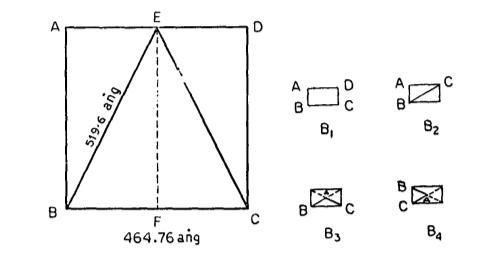
The following four types of bricks are prescribed:
B1 – a rectangular brick, bṛhati, or 10 sq.aṅgulas.
B2 – a triangular brick half of the bṛhati, diagonally intersected.
B3 – a triangular quarter brick with long base, dirgapādyā.
B4 – a triangular quarter brick with short-base and pointed like a pear, śūlapādyā.
Ubhayata–Prauga-citi
The following passage from Baudhayana-Sulbasutra (BSS) (3.161-71) gives the measurement of the bricks required for constructing a fire altar namely Ubhayata–Prauga-citi (15.1-2). उभयतः प्रौगं चिन्वीतेति । यावानग्निः सारत्निप्रादेशस्तावदुभयतः प्रौगं कृत्वा नवमेन तिर्यङ्मान्याः प्रौगचितावता विकाराः । It explains the construction of a fire altar in the shape of a rhombus with short diagonal say, BC = 120 √15/2 and side BG = 300 √5/2 . It gives the proportion of the sides of the rectangular and triangular bricks: चतुर्विधाः इष्टकाः उपयुज्यन्ते (१) दीर्घचतुरस्र-इष्टकाः (बृहती), अङ्गुलवर्गः ; (२) त्र्यस्र-इष्टकाः अर्ध बृहतीपरिमाणाः, (३) त्र्यस्र-पाद-इष्टकाः दीर्घभुजान्विताः (दीर्घपाद्याः), (४) त्र्यस्र- पाद-इष्टकाः ह्रस्वभुजान्विताः (शूलपाद्याः)।
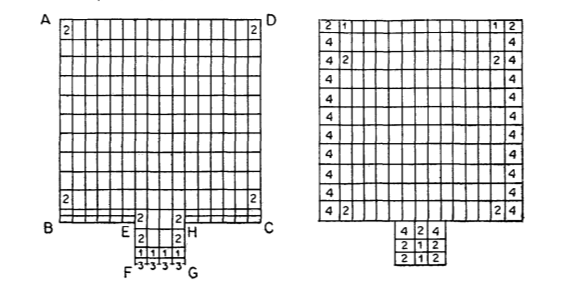
Sizes and shapes of the bricks to construct a Ubhayata–Prauga-citi, are seen (in the form of proportion). Four types of bricks are needed-
- Rectangular bricks (bŗhatī) of the size square inches: 120/9 √15/2 X 120/18 √15/2.
- Bricks in the shape of triangle whose side is half of bŗhatī size
- Bricks with triangle as the base whose side is one fourth of the length of the rectangle i.e side of triangle = ¼ (120/9 √15/2)
- Bricks with triangle as the base whose side is one fourth of the breadth of the rectangle i.e. side of triangle = ¼ (120/18 √15/2)
Ubhaya-prauga-citi (Rhombus)
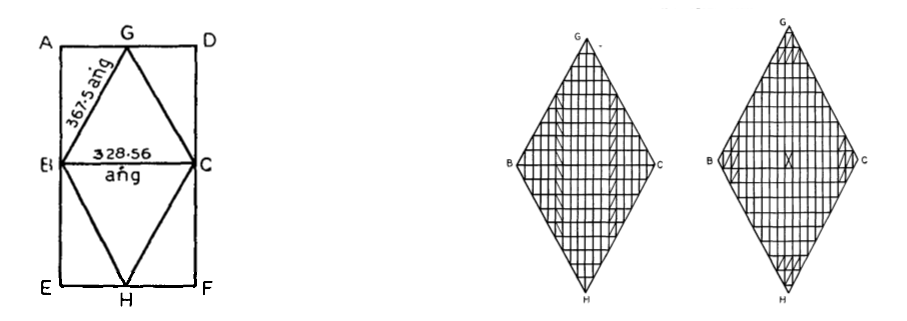
Fig. Measurement of areas and bricks. Fig. Arrangement of bricks in 2 layers
Following the size, measurements, shape, number of bricks given in the Śulbasūtras, the citis can be constructed even today and that will become architectural marvels. The measurements can be given in the corresponding current measures.
Construction of a Śyenaciti:
Baudhāyana, Āpastamba and other śulbakāras have considered the construction of two categories of falcon-shaped fire-altars.(a) the first category in which the body, the wings and the tail are rectilinear (squares and rectangles), and (b) the second category in which the wings are curved, the tail is spread out, and the body and the head have their corners cut off. In the latter case the shape of the altar more closely resembles the falcon.
Construction of a Fire-altar in the form of a Falcon with curved wings and extended tail – (BŚs.10.1):
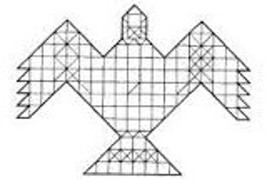
To construct this falcon shaped citi, the two wings are to be curved or bent and tail is to be spread out. The body (ātman) itself should be cut out at its four corners, and there should be a head. The end of each wing is serrated to give it the appearance of being provided with feathers (patra). The laying of this type of fire-altar for those who desire heaven, has been emphasized in the brāhmaṇas (Śatapatha Brāhmaṇa. X.2.1.1 – 2.1.4)
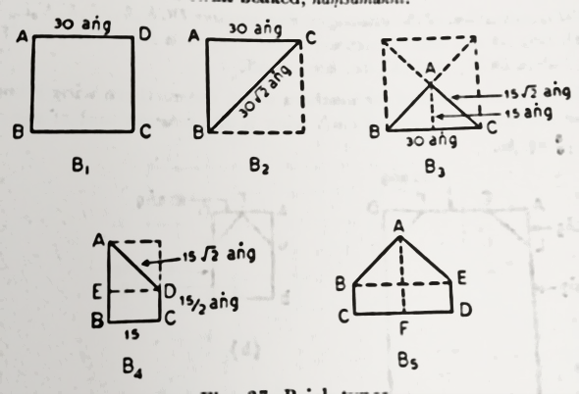
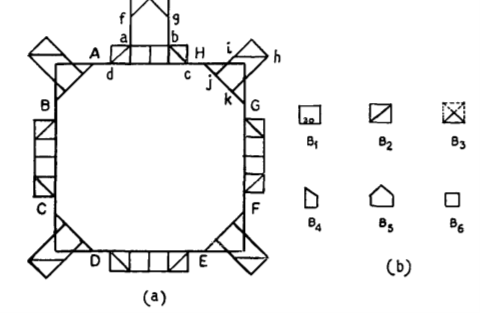
Types of bricks to be used (BŚs.10.2-10.3): For this construction of fire-altar in the shape of a falcon, five types of bricks are to be used.
B1 : one-fourth (caturthī) square brick- 30× 30 sq. aṅgulas; that is, a square whose side AB is ¼ pu.or 30 aṅgulas.
B2 : half brick (ardha) obtained by cutting the one-fourth square brick diagonally; each of 2 sides AB, AC equals 30 aṅgulas and the diagonal side or hypotenuse BC = 30 √2 aṅgulas.
B3 : quarter brick (pādyā) , obtained by cutting the one-fourth brick diagonally;
B4 : four-sided quarter brick (caturaśra-pādyā) of which CD equals 15/2 aṅgulas, BC 15 aṅgulas, AB 22½ aṅgulas. AD 15 √2 aṅgulas, 1 pada being 15 aṅgulas; such a figure is obtained by joining the rectangle EBCD with the isosceles right triangle AED along the common side ED. Its area is (15X15)/2 + (15X15)/2 sq. aṅgulas = 15 ×15 sq. aṅgulas, the same as B3.
B 5 :half brick ABCDE obtained by joining two B4 s along their common longest side AF; this is also called swan-beaked (haṃsamukhī ).
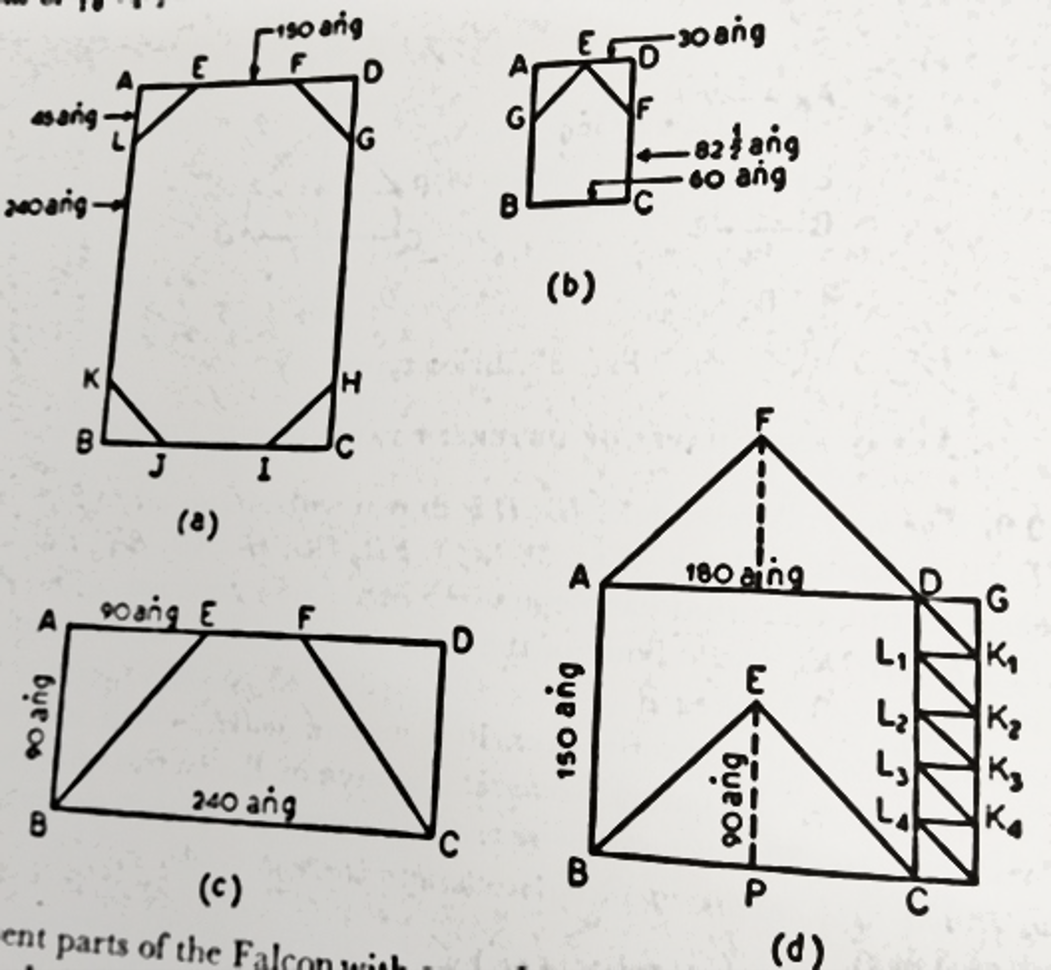
Fig. Different parts of the Falcon with curved wings and extended tail – (a) body; (b) head; (c) tail and (d) wing with plumages (patra) – first type.
In each part of the falcon, in each layer, how many bricks of each type to be placed is given in detail, so that the citi can be constructed.
For the following altars the details of construction are not given here.
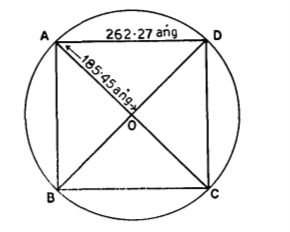
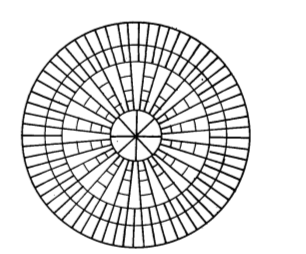
Rathacakra-citi (Chariot wheel)- BŚS.16.1- 16.3:
Droṇaciti (Square trough) Śmaśāna-citi (Pyre)
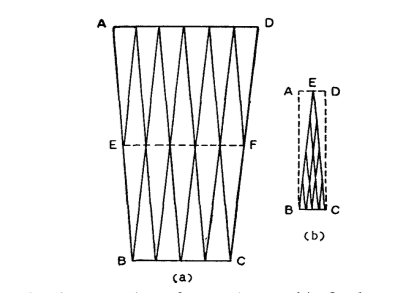
Kūrma-citi (Tortoise)
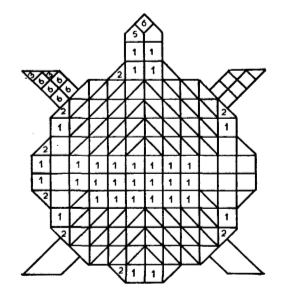
The description of the construction, with the proper shape and size and measurements of the bricks, of the different fire-altars reveals the advanced knowledge of our ancient Indian seers in geometry and mensuration in the Śulba period (earlier than 800 BCE) itself.
Reference
Gupta, R.C., 1988, “New Indian values of p from the Mānava śulbasütra”, Centanrus (Denmark) 31, pp. 114-125
The Śulbasütras, text with tr.by S.N.Sen and A.K.Bag, 1983 .