Śulbasūtras are the earliest written literature available which contain mathematical concepts that have a lot of geometrical content. For performing the yajñas (sacrifices), the fire altars are to be constructed in different geometrical shapes. When the different shapes need to have the same area, one geometrical figure is transformed into another with equal area. The seers had enough knowledge of geometry to construct different vedis and citis (altars for yagas). Śulbasūtras contain aphorisms which give instructions for the constructions of different geometrical figures. The constructions needed to be perfect because they believed that the yajñas would not yield desired results if the construction of the citis were not accurate.
Before the advent of different advanced instruments, long ago, in ancient India, our ancestors had the knowledge of doing complex constructions with the help of simple instruments called rope and nails. Śulba means rope, sutra means aphorism. So portion of the Vedāṅgas which contains the details of constructing Vedic-altars in various complex shapes like quadrilaterals etc. are called Śulbasūtras.
Most of the constructions that are done at present are explained in the Śulbasūtras. Some of them are (i) constructing east-west line and a line at right angles to a given line at a point on it and from a point outside; (I i) dividing a line segment, circle and triangle into equal parts; (iii) constructing a square of given side, a square of area equal to the sum of two different squares, a square equal in area to the difference of two given squares, a square equal to a given rectangle or a triangle or two pentagons or a rhombus; (iv) constructing a parallelogram, a trapezium, a rectangle, a rhombus etc. (vi) transforming a given square into a rectangle, rhombus, isosceles trapezium etc. and vice versa.(vii) transforming a square into a circle and vice versa and many more constructions and transformations. A few constructions from Śulbasūtras are presented here to familiarise the readers with the proficient knowledge of the Śulbakāras.
(i)Determining the East-west line
This was preliminary to the construction of all the altars and fire places described in the Vedic literature. Kātyāyana and Mānava give the details of the procedure.
Kātyāyana Śulbasūtra (1.2) gives the rule for determining the east west line:
समे शङ्कु निखाय शङ्कु, सम्मितया रज्वा मण्डलं परिलिख्य यत्नःलेखयोः शङक्वग्रच्छायाः निपतति तत्र शङ्कु निहन्ति सा प्राची ।
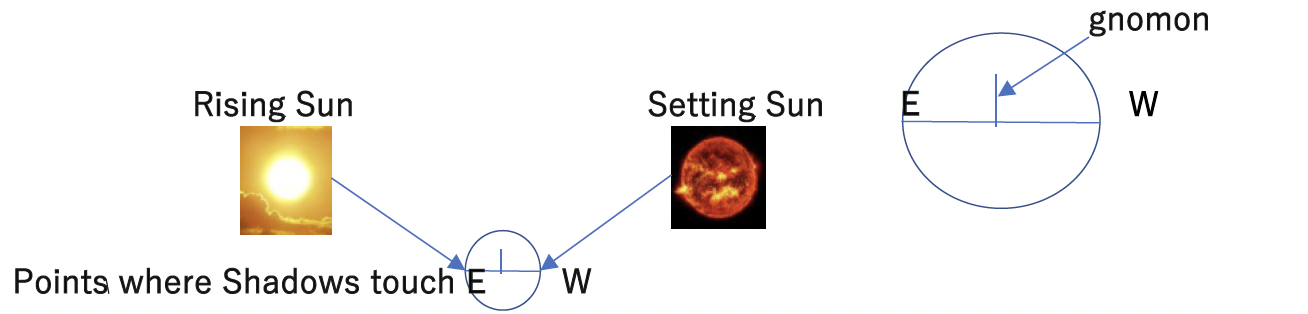
A gnomon (pole), usually 12 inches high, is fixed in the ground and a circle is drawn around it with the radius equal to the length of the gnomon. At 6 am the point E is marked when the shadow touches the circle. At 6 pm again the point W is marked when the shadow touches the circle.The line EW is called East-West line, called prācī’. This is the basis for all constructions.
(ii) To draw perpendicular bisector of a given line
The method is explained by Kātyāyana in connection with fixing the udīcī, the north-south line, after the east-west line is fixed.
Kātyāyana (1.3) gives rule to draw perpendicular bisector of a given line.
तदन्तरं रज्वाभ्यस्य, पाशौ कृत्वा, शङ्क्वोः पाशौ प्रतिमुच्य, दक्षिणायम्य मध्ये शङ्कुः निहन्ति । एवमुत्तरतः सोदीचि ।
Construction of perpendicular bisector: Fish-figure method
In the East-West line, a point is marked. Having this point O as centre, with a fixed equal radius two arcs are drawn which cut the East-west line at two points E and W. With radius equal to the length of EW, with centres at E and W, two more arcs are drawn as in the figure. The line joining the points of intersection of these two arcs is the perpendicular line or North-South line (udīcī).
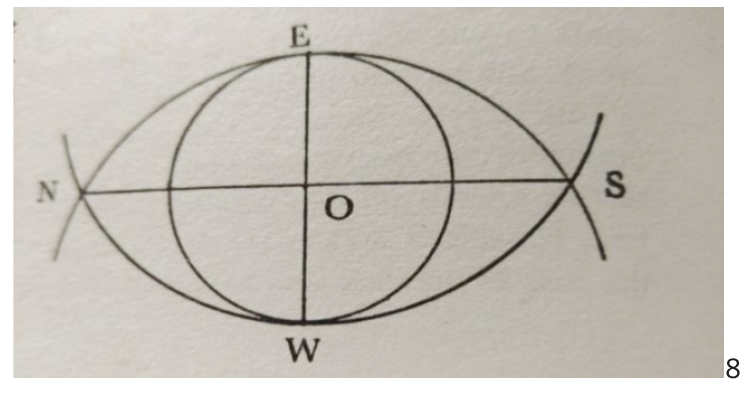
NS EW; Perpendicular by Fish-figure method.
Construction of square (with Bamboo)
Square is a common figure in Geometry. Śulbakāras suggest several methods to construct a square. One practical method of constructing a square is described here. The most primitive method of getting a square is based on drawing a perpendicular bisector to a given line from its midpoint. Baudhāyana Śulba-sūtra suggests to take a bamboo equal to the length of the side of a square. (BŚs. III.13-15)
यावान्पुरुष ऊर्ध्वबाहुस्तावदन्तराले वेणोश्छिद्रे करोति । मध्ये तृतीयम्। यदमुत्र स्पन्द्यया करोति तदिह वेणुना करोति।
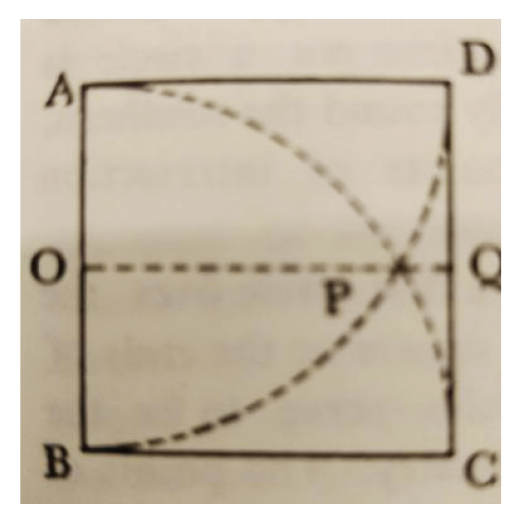
Let AB be the line with O as its centre. A bamboo equal to the length of AB is first pivoted at A and the free end is rotated as shown. Then the bamboo is pivoted at B and the other end is rotated. These two arcs meet at P. Join OP and extend. Finally place the bamboos or draw lines tangential to these curves. We thus get square ABCD.
Construction of a rectangle and a trapezium (ekato’ṇimat– smaller on one side)
The square, rectangle, trapezium etc. are constructed with the help of right triangles. East- west line and North-South lines are constructed. Several triplets of sides of right triangles are given by Äpastamba ( ĀŚs. V. 2 -5): (36, 15, 39), (3,4,5) ; (12, 5, 13), (15, 8, 17) and (12, 35,37).
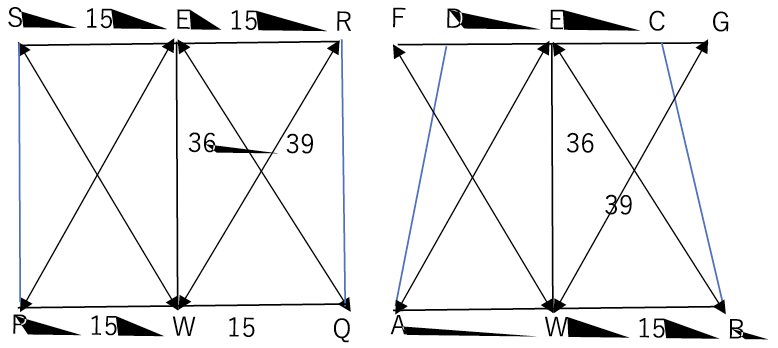
Let us take the triplet , three sides of right triangle, (36, 15,39). Mark 36 along the East- West line (EW), and 15 (WQ= WP= 15) along North-South line. Construct right triangles EWS and EWR, PEW and QEW with sides (36, 39,15). Then PQRS is the constructed rectangle.
Method used to construct a trapezium is the same as for the construction of the square and the rectangle using a right-angled triangle. Mark 36 along the East- West line (EW), and 15 (WA= WB= 15) along North-South line. Construct right triangles EAW and EBW, WFE and WGE with sides (36, 39,15). Mark C and D along FG such that EC = ED . ABCD is the required trapezium.
Baudhāyana recommends his method for constructing a rectangle for the construction of a trapezium also (I.36 – 41), i.e. drawing the perpendiculars at the extremities, by the isosceles triangle method and then marking off the half sides on these.
Constructing a square equal to the sum of two given Squares
नानाचतुरश्रे समस्यन् कनीयसः करण्या वर्षीयसौ वृध्रमुल्लिखेत् । वृध्रस्य अक्ष्णया रज्जुः समस्यतोः पार्श्वमानी भवति। (BŚs .2.1.-2.2)
‘To combine two different squares, mark a rectangle (vṛddram) in the bigger square (varṣīyasaḥ) with a side equal to side of smaller square (kanīyasaḥ). The diagonal of this is the side of the sum of two given squares,’
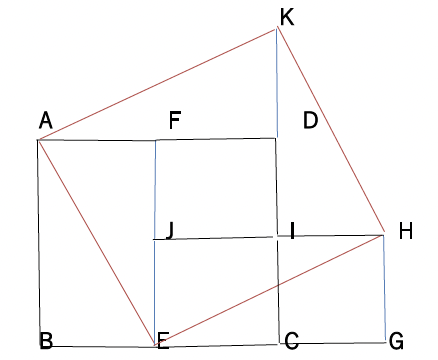
Given : Bigger square ABCD and smaller square CGHI.
Mark E on BC such that BE =CG. Complete rectangle ABEF. Then square on AE i.e.AEHK is the required sum of two given squares. This incidentally proves the śulba theorem (the theorem on the square of the diagonal, the so called Pythagoras theorem at least two centuries before Pythagoras)
Square AEHK = AE2 = ABCD + CGHI
= AB2 + CG2 = AB2 + BE2 .
Only a few constructions are shown here. There are a lot more interesting and ingenious constructions instructed in the Śulbasūtras, which show the great knowledge that existed among our ancient seers about 3000 years ago. In the next section we will deal with some of the transformations, that is, transforming one geometrical figure in to another of equal area and construction of various citis like Çyenaciti etc.