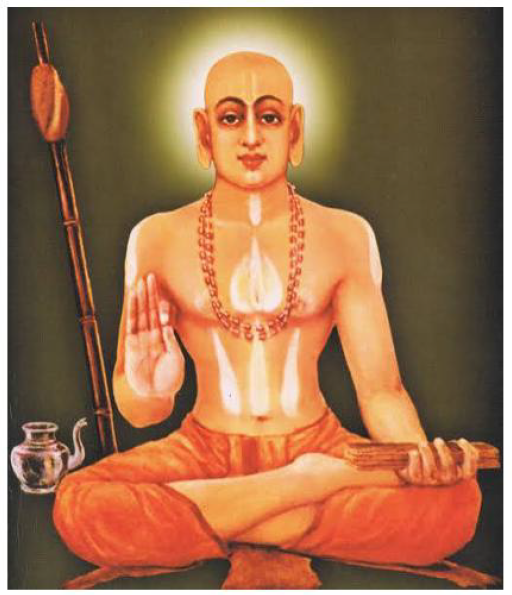
 Madhvacharya was a great Vaishnavite saint, a reformer, a scholar and proponent of Dvaita school of philosophy. He was instrumental in creating a powerful Bhakti movement in India. According to him, liberation from the world of miseries is attained only through devotion. Udupi, nestled along the Arabian sea in Karnatakaa is the spiritual centre where Krishna temple created by Sri Madhvacharya is located. The temple of Sri Chandramouleeswar temple and that of Anantheswar are also located here.
Though Madhyagehar- Vedavati couple were blessed with two sons, both the children died very young. They then shifted their residence to Udupi. As a result of intense prayer made to Lord Anantheswar for over 12 years, they were blessed with the boy. The priest of the temple had said that the wind God, Vayu has manifested as their son. The parents named him as Vasudeva. Vasudeva received his basic education from his father. The lessons included Sanskrit, moral and spiritual values. His mother made it a practice to take him to spiritual discourses. He listened to these discourses and analyzed them with his own understanding. At the age of seven, he was initiated to the order of Brahmacharya by conducting the Upanayanam ceremony. Vasudeva was deputed to Thottam Thillayya, an erudite scholar for studies on Vedas, scriptures, literature and art. The Pundit observed that Vasudeva was brilliant not only in his studies but also in other activities like sports. Vasudeva realized that he should distance himself from worldly life and aspired to reach higher state of knowledge. He started looking for a Guru who would guide him and lead him to his right destination. When a person sincerely starts searching for a Guru, invariably the Guru appears before him at some point of time. When Vasudeva happened to meet Achuta Prajna Teerthar, he was happy that he found his right Guru. Achuta Prajna was the Master of Vedanta and Head of Pandarkara Math at Udupi. Vasudeva prostrated at the feet of Achuta Prajnar and requested to accept him as his disciple. The parents who were blessed with the only son, Vasudeva, expressed their disapproval. Madhyagehar, the father, tried to persuade his son not to go for Sanyasa. First he made requests and when the son was not relenting, he even fell at the feet of the son. When a father unusually falls at the feet of the son, it signifies that father unconsciously accepts the saintly qualities of his son. According to Dharma Sastra, a father cannot fall at the feet of the son unless the son happens to be a Sanyasi. Addressing the father, Vasudeva said: “By falling at my feet, you have indirectly agreed to my initiation as Sanyasa”. Madhyagehar therefore accepted his fate and went back to his village. When Achuta Prajna was camping with Vasudeva at a place called Kayuru, Madhyagehar came again and met his son who had not yet been initiated to Sanyasa. Addressing the father the son said: “You are concerned because you feel the need for a son to take care of you. I promise you that till you get another son and till you give whole-hearted consent, I will not adopt Sanyasa”.
Years later, when Madhyagehar and Vedavati were blessed with a son, Vasudeva went and saw them, took their blessings for taking up Sanyasa. Vasudeva firmly believed that a mother’s permission is essential for the son to take Sanyasa and he waited till conditions became favourable and mother willingly gave permission. Soon, on an auspicious day, when the whole town of Udupi had turned up, witnessed by Pundits, Sri Achuta Prajna formally initiated Vasudeva to the order of Sanyasa. He was given the name Purnaprajna (One who is completely conscious). Sri Purna Prajna kept himself engaged by doing service to his Master, by performing Puja and by performing Bhagavata Parayanam. Sri Achuta Prajna found Purna Prajna interpreting Vedic doctrines very authoritatively. Soon, the Acharya declared that Purna Prajna would succeed him as head of the Math. Purna Prajna was named as Ananda Tirtha.
The Pandarkara Math presided over by Sri Ananda Tirtha became a venue for deliberations of spiritual activities and debates. Pundits from many other places used to come and participate in debates on Vedanta. Sri Ananda Tirtha contemplated, analyzed and assimilated all aspects of Vedanta and then came out with his own philosophy. Till then, only Adi Sankara’s Advaita philosophy was predominant, but Sri Ananda Tirtha put forward his theory which basically differed from that of Adi Sankara. According to him, Lord Vishnu is the highest power in the whole universe and the individual soul is a separate entity. But Guru Achuta Prajna differed from his disciple because he subscribed to Sankara’s Advaita doctrine. Achuta Prajna held the view that a new theory, different from the commonly accepted theory of Advaita, has to be discussed, debated and accepted by Pundits before being recognized and Ananda Tirtha agreed with it. Ananda Tirtha invited Pundits from different sections, engaged in serious discussions and convinced them by advancing his arguments reasonably.
Though he was named as Sri Ananda Tirtha, over a period he came to be known as Madhvacharya. According to the order of Sanyasa, a saint should never remain at one place and keep moving. Acharya then embarked on a long pilgrimage along with Sri Satya Seelar, a disciple of Achuta Prajna. Starting from Udupi, he went to Bengaluru, Vishnumangalam, Kochi, Thiruvananthapuram and Kanyakumari. At Kanyakumari he happened to meet a saint who was none other than Sri Vidyasankara Tirtha, the head of Sringeri Math. After the long pilgrimage which covered places like Rameswaram and Srirangam, Madhvacharya returned to Udupi. He then authored an excellent commentary on Bhagavad Gita which was appreciated by many scholars and intellectuals. After a gap of few days, Madhvacharya embarked on his second leg of pilgrimage, accompanied by Sri Satya Teerthar and reached Varanasi. After bathing at Ganga, they proceeded north and reached Badari. At Badari, Acharya remained in a state of Samadhi for many days. It is believed that Veda Vyasa manifested in a human form, appeared before Madhvacharya and blessed him. Madhvacharya composed Brahma Sutra Bhashyam from Badari. After passing through Bihar, Bengal and Orissa, Madhvacharya and Satya Seelar reached banks of Godavari. Here, he met Sri Sobana Bhattar, a great Jnani. Though Sobana Bhattar disagreed with the philosophy of Acharya, after prolonged discussion and debate between the two, Sobana Bhattar agreed and became one of the disciples of Acharya.
Having reached Udupi, Acharya got message from King Jayasimha of Kumbanadu to come and collect the precious manuscripts which he had retrieved. At Kumbanadu, Acharya was accorded a warm welcome. During his visit to Vishnumangala, a Pundit by name Trivikrama questioned the philosophy of Acharya. After a serious debate which lasted 15 days, Trivikrama prostrated at the feet of Acharya and accepted him as Guru.
After the demise of his parents, even his younger brother became a disciple of Madhvacharya. Madhvacharya composed his works elaborating his theory of Dvaita Sidhanta, He explained his doctrine with reason and logic and convinced the doubters. Though it was a hard task for Madhvacharya to convince his teacher, Achutaprakasha, by his scholarly qualities and power of reasoning, he succeeded in converting even his Guru . It then became a rare case of a guru becoming the disciple. At Udupi, Madhvacharya established the Krishna temple which became a great spiritual centre.
Udupi Krishna: When a ship carrying precious woods was proceeding in western ocean, suddenly the weather condition became worse and the ship lost its balance. Madhva who was doing meditation at the shore found it and rescued the ship by his divine spiritual powers. Though the pleased captain came forward and said that he would offer anything, Madhva said that he wanted only two pieces of chandan formation. The captain instantly gave the pieces to Madhva. Later, when the outer formation was removed, the beautiful young image of Krishna became visible. Madhva took the idol of Krishna and installed it at the temple. It is believed that this Krishna idol was worshipped even by Rukmini. According to legend, Rukmini wondered how blessed mother Yasodha was, who used to attend to young Krishna, put him at her lap and love him at close quarters. Rukmini then asked Krishna whether she can have the same experience and Krishna was too willing to oblige her. He took the help of Viswakarma and got the young image of Krishna and presented to Rukmini. At the end of the age, the idol which Rukmini held was kept in the forest and later got mixed with the woods there. It was this formation along with other woods the captain was carrying for merchandise and ultimately landed in the hands of Madhvacharya.
There are eight spiritual descendants of Sri Madhvacharya who head the eight Mutts in Udipi. Only the heads of the eight Mutts are endowed with the power of attending to the idol like anointing, adoring, garlanding and decorating. The system by which they conduct the Puja of the idol by turn is known as ‘Paryaya”.The Swamiji in charge of worship is called ‘Paryaya Swamiji’ and the Mutt is called Paryaya Mutt. Krishna Darshan is done through the Navagraha Kindi (hole). According to legend, a devotee by name Kanakadasa came to worship Lord Krishna but he was not allowed inside on the false ground of being low caste. As he was true devotee, Krishna gave him Darshan by creating a small hole in the back wall of the temple and turned to face the hole so that Kanakadasa could see him. This hole is known as Kanakana Kindi.
Madhva’s teachings: Madhvacharya’s philosophy is based on the doctrine of dvaita (dualism). According to this theory, Vishnu, the Brahman, is the eternal reality and ever remains independent. Refuting the theory of oneness, he says that there exists difference between God, living being and non-living beings. He lists the differences (1) between God and individual soul, (2) between God and matter (3) among individual souls and 4) among various types of matter. Contrary to the theory of world being a myth, he believed in the reality of the world. He ascribes everything to the power of a single supreme God whom he called Narayana. He said that Vishnu, the Lord of infinite qualities is free of all limitations. He is distinct from all other beings who depend on Him. Madhvacharya repeatedly reiterated the independent character of Vishnu. His concept of Vishnu is more than a deity. Vishnu is Brahman, the eternal reality. Vishnu alone is independent and all others are dependent. He has liberally quoted from Sruti to emphasize the importance of the Supreme Lord, Hari. Acharya ascribes all functions like creation, sustenance and destruction to Lord Hari. He said Prakriti (nature) is the material cause for this world and not Brahman. It is the Brahman which activates the nature. Vedas give not only ritualistic knowledge (Apara Vidya) but also spiritual knowledge, the Paravidya. He has accorded the highest importance to devotion. Bhakti is unshakeable love towards God which alone serves as means for liberation. Madhvacharya repudiated the theory of knower and the known being the same. In fact, there should be a knower (subject) at one end and the known (object) at the other end. Like Sri Ramanuja, Madhvacharya equates Brahman, the ultimate reality with Vishnu. Vishnu has many attributes. He is light and he is darkness. He symbolizes knowledge and ignorance. He is creator and destroyer. He is everything and therefore Upanishad says: “He is smaller than an atom and bigger than the biggest. He has said that Atman, the pure consciousness, exists in the cavity of heart. Madhvacharya has authored 37 sacred texts known as Sarvamoola Granthas. His works are as follows:
- Gita Bhashyam. Gita Bhashyam is the first work of Madhvacharya. He enters into the world of devotional literature through this work. This work which opens up by invoking the blessings of Lord Vishnu and Sage Veda Vyasa, looks at Vedanta from a new different angle. He has adopted the style of brevity, clarity and a liberal use of quotations. He said that Bhagavad Gita is the essence of the epic Mahabharata. He explained the Karma Yoga and stressed the importance of active life. He has also described the different manifestations of Lord Vishnu and concluded by saying that devotion is the only way for liberation.
- Brahma Sutra Bhashyam deals with the ways by which one attains the highest knowledge, Para Vidya; the knowledge of ‘Aham Brahmasmi’.
- Bhagavata Tatparyam. Out of the total of 18,000 hymns, Sri Madhvacharya has given commentary for 1600 hymns. Wherever reference is made in Bhagavatam to oneness of Jivatma and Paramatma, Madhvacharya gives elaborate explanation on duality.
- Commentary on Mahabharata: He said that the rare truths which are not traceable in Vedas are found in Mahabharata. According to him Mahabharata symbolizes victory of goodness over evil and victory of believer over non-believer. Madhva has given his commentary only after studying and analyzing various other similar works. In this commentary on Mahabharata, he has given detailed interpretations to the doctrines lof Karma Yoga, Bhakti Yoga and Jnana Yoga.
- Commentary on Upanishads: In the context of Advaita doctrine mentioned in various Upanishads like Ishavasya Upanishad, Kathopanishad, Mundaka Upanishad and Taithriya Upanishad, he has given innovative interpretation of Dvaita. In Kathopanishad, Acharya said that Nachiketas got the blessings from the God who appeared externally. He said he found God in the waves of the ocean, in the thunder of clouds and in the mingling sound of the trees. He said that Lord Vishnu is the eternal reality. According to him, all the knowledge that one derives is out of his devotion towards God. He has given commentary on Aitreya Upanishad which explores the origin of the universe and the nature of Self, the ever existing reality. After explaining this Upanishad he exhorted his disciples to highlight its importance to those who are qualified to learn it.
- Rigveda Bhashyam. The first hymn in Rig Veda is worshipping the God of Fire (Agni). The hymn “Agnimeele Purohitam” indicates that Agni and Lord Vishnu are the same.
Apart from Bhashyam on Brahma Sutra, Upanishads and Puranas, Acharya has also composed devotional works like Krishna Jayanthi Nirmayam, Narasimha Stuthi and Krishnamruta Maharnavam. He said when an individual reaches the age of 14, he starts doing sinful deeds which would result into 10 new births. According to him, the only way to come out of Karma is the way of devotion. A glimpse of Madhvacharya’s life is available from Madhava Vijaya, a Sanskrit work authored by Sri Narayana Pandita.
A sect called Gaudiya Vaishnavas, hailing from Orissa and West Bengal follows the principle of Madhvacharya. A famous saint who is considered as manifestation of Lord Krishna was Chaitanya Mahaprabhu who appeared in Mayapur at West Bengal. The ISKCON movement traces its origin to the Bhakthi movement propounded by Sri Chaitanya Mahaprabhu.
Acknowledgement:
- Bhakti School of Vedanta by Swami Tapasyananda published by Sri Ramakrishna Math, Madras 4.
- “Jnana Paramparai” compiled and presented by Arut Selvar, Dr N. Mahalingam.