Sri Sivanadalahari by P. R. Kannan published by Giri Trading, Chennai, pp.400, Rs.250

A jasmine creeper fills an entire forest with its fragrance and purifies the environment. The writings and lectures of Jagadguru Seva Ratnam Upanyasa Tilakam Shri. P.R. Kannan, Engineer turned philosopher cum Spiritualist are too well known and need no reiteration.
I have been an ardent student of his lectures for more than 5 years now. Though an octogenarian he delivers his Upanyasams with the enthusiasm of a youth coupled with the maturity of his age.
Recently I went through his latest book Sri Sivananda Lahari based on his lectures delivered on internet for the devotees all over the world. I was also a beneficiary of these lectures as an ardent student.
Sivananda Lahari is considered as an authentic exposition of Bhakti just as Saundarya Lahari as a gem of poetic beauty extolling the Divine beauty of Devi, both compiled by Adi Sankaracharya considered as the incarnation of Lord Dakshinamurthy Adi Guru. Jagadguru and Adi Guru are one and the same.
Having listened to Sivananda Lahari lectures by Sri. Kannan and other upnyasakars I personally feel that Sivananda Lahari is not a mere Bhakti stuthi. In fact it emphasises that Bhakti is not a mere tool to attain liberation i e. Mukthi, but Bhakti is itself Mukthi slokas 28 33 and 81. Sri. Kannan has brought this out beautifully in his book.
Narada Bhakti Sutram is considered an authority on Bhakti cult. Sivananda Lahari describes all the stages of Bhakti and Sri. Kannan has given an excellent table on this aspect, page 361 of his book.
As one who has listened to his lecture I admire unabashedly that on several days I was moved to tears. Siva Bhakti anuboothi was experienced by me thanks to Sri Kannan’s inimitable exposition.
The book is a boon to all readers.
May Lord Siva who is an Asutoshi bless all the readers of Sri Kannan’s book which is a must in every Library.
– T. S. Santhanam
Śrī Gaṇeśa Bhajanāmṛtam by Mumbai Ramakrishnan LKM Publication, Chennai, pp.170, Rs.120/-
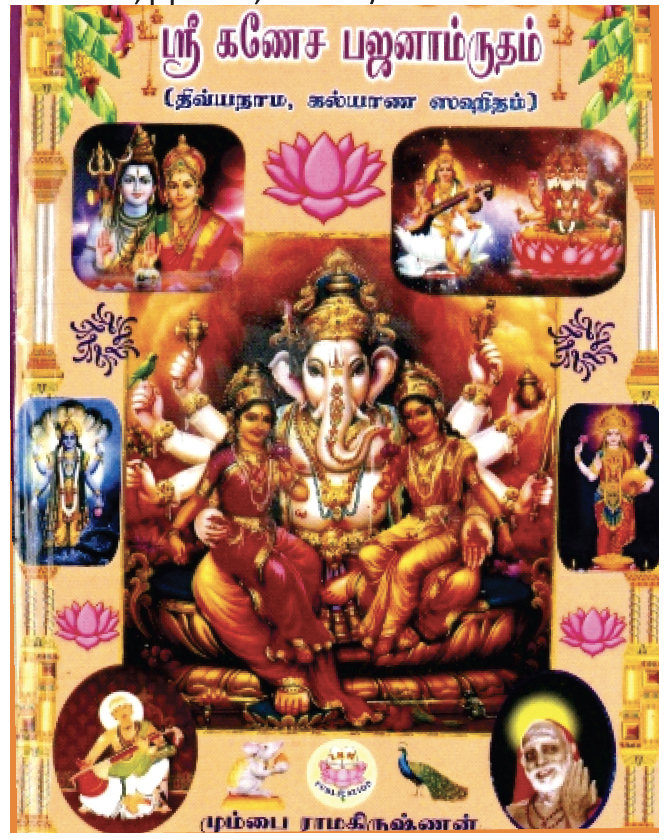 At present, he has brought out this book under the title Śrī Gaṇeśa Bhajanāmṛtam (with Divya Nāma Kalyāṇa), compiling numerous items such as songs, kīrtanas, aṣṭapadis, and aṣṭottara hymns glorifying Lord Piḷḷaiyār.
Through this book, we generally understand that since Piḷḷaiyār (Gaṇeśa) resides independently in all temples, we have been thinking that he is a brahmacārī (celibate). Although we have also seen and worshipped him in some temples appearing together with Siddhi and Buddhi as his consorts, for some reason our mind hesitates to accept that Piḷḷaiyār is a married deity. Is Pillaiyār a brahmacārī? Or is he married? — in order to put a full stop to this inner conflict of the mind, an explanatory essay addressing this question has been included in this book.
Beginning auspiciously with Toḍaya maṅgalam and followed by beautiful meditation verses (dhyāna ślokas), starting with Dakṣiṇāmūrti, including Guru kīrtanas dedicated to all the Gurus of the land of Bhārata, the author has strung together, like a garland of nine gems (navaratna mālai), songs in the styles of many different composers (vāggeyakāras).
Under the title “Gaṇapati Songs,” it is special that the works of everyone — Svāmi Haridās giri, Papanāsam Śivan, Aruṇagirinathar’ s Tiruppugazh, Ādi Śaṅkara’s Śrī Gaṇeśa Pañcaratnam, and Avvaiyār’s Vināyagar Agaval — have all been brought together in this Gaṇapati Bhajanāmṛtam. Further, songs meant for dīpa pradakṣiṇa, and kummi and kolāṭṭam songs, including compositions of Agastya and Kaduveli Siddhar, have also been included.
After completing all the Gaṇapati worship (ārādanās), the third section of the book leads us into the stage of marriage. The fact that the author has carefully selected and included songs for every single marriage ritual, without omitting any, clearly reflects his intensive research and dedicated effort.
The bhajana sampradāya is a simple yet exalted form of devotion. Well suited to the Kaliyuga, in which many join to sing hymns of praise, this book serves yet another ornament enriching the bhajana tradition.
– Dr. Lavanya V. Eswar, KSRI
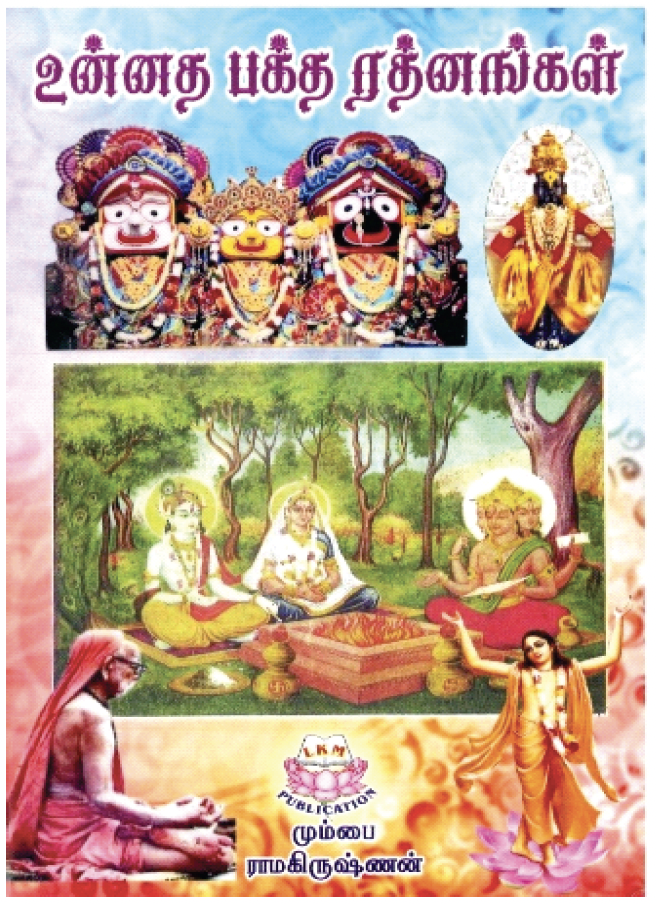
Unnatha Bhakta Ratnaṅgaḻ by Mumbai Ramakrishnan, L K M Publications, Chennai, pp. 178, Rs. 150/-, 2024
 Countless are the great souls in our sacred Bhārata who, fixing their minds on the Lord, merging in Him a lone, losing the individuality of their limited soul-consciousness, and delighting entirely in the divine awareness of the Supreme, lived immersed in the state of God. It is because of such souls that this Bhārata shines as a holy land of sacred pilgrimage.
The special feature of this book Unnatha Bhakta Ratnaṅgal by Mumbai Ramakrishnan is that it briefly presents the lives of devotees who lived in various sacred pilgrimage centres across Bhārata. The author concisely narrates the histories of twenty-four realized saints who lived and attained liberation in four holy kṣetras—Jagannātha Kṣetra, Brindāvana Kṣetra, Kannaḍa Kṣetra, and Paṇḍaripur Kṣetra. Moreover, besides their life histories, he has also included several important notes and observations related to them.
This book includes eight dāsas of the Jagannātha kṣetra, Mādhava Deva of the Assam kṣetra, eight dāsas of the Brindāvana kṣetra, two dāsas of the Kannaḍa kṣetra, and five dāsas of the Paṇḍaripur kṣetra. As one reads the accounts of the divine plays and sacred deeds through which the greatness of these devoted dāsas became known to the world, the level of our own devotion inevitably rises.
About the Author:
Although professionally a civil engineer and recipient of the Navaratna Award from the Builders’ Association of India, Sri Ramakrishnan has been immersed in bhajans since childhood. His family background is closely linked with revered personalities such as Śrī Jayendra Sarasvati Svāmigal, Śrī Ramaṇa Mahariṣi, Śrī Sādhuram Svāmigal and Pāpanasam Sivan. He has been performing traditional bhajans and divine marriage (kalyāṇam) performances for over 57 years (since 1968) across India and abroad. He has authored 34 books aimed at inspiring devotion and preserving Bhajana traditions.
– Dr. Lavanya V. Eswar, KSRI