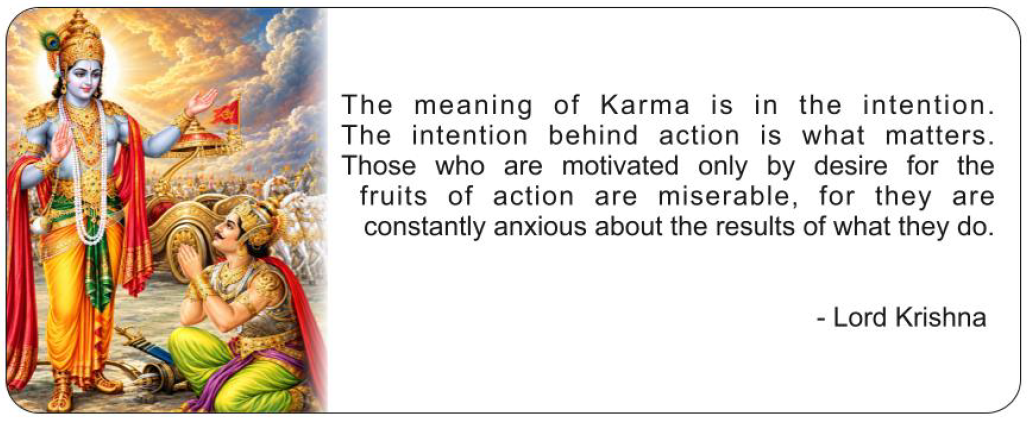
 Sri Krishna explains to Arjuna that a spiritual aspirant endowed with sadhana chatushtaya sampatti (discrimination, dispassion, discipline, and a desire for moksha), who studies Vedanta under the guidance of a Guru through sravanam and mananam, becomes established in Pure Consciousness, Brahman, through nidhidhyasanam.
The aspirant consciously cultivates the qualities that arise spontaneously in a sthita-prajna. A sthita-prajna is atma tushta:, sarva kama tyaga:, sarvada sama:, viragi, abhaya:, akrodha:,na abhinandati, na dveshti, na kankshati, anabhisneha: (rejoices in the self, has no desires, is equanimous, dispassionate, fearless, does not get angry, rejoice or hate favourable or unfavourable situations, hanker over enjoyments, remains unattached). We as spiritual aspirants should check ourselves against these to see how to be a sthita prajna.
Sloka 69
In sloka 69, Bhagavan Sri Krishna compares jnani (wise) with ajnani (unwise).
या निशा सर्वभूतानां तस्यां जागर्ति संयमी।
यस्यां जाग्रति भूतानि सा निशा पश्यतो मुनेः।।2.69।।
या निशा सर्वभूतानां – what appears to be like night for ajnanis that is advaita brahma tattvam – it is clear like day for jnani
तस्यां – in that advaita tattvam
जागर्ति संयमी – sthita prajna’s mind is alert and absorbed
यस्यां जाग्रति भूतानि – that (dvaitam/ plurality) which ajnanis are alert to
सा निशा पश्यतो मुनेः – is night to a sthita prajna.
For sthita prajna, jnana has gone to the subconscious level. Both jnani and ajnani are in the same world, going through the similar sukha-dukha experiences based on their individual prarabdha karma (result of past karma). A jnani does not attach undue importance to the experiences arising from either worldly or religious duties. His intellect does not get absorbed in any experience, whether joy or sorrow, praise or criticism, gain or loss, success or failure, ill-health, etc. He is clear that all this is maya. To a jnani, the world’s existence is a mere appearance. Whereas ajnani gives importance to every incident and worries about the past, present or future.
To understand this complex sloka, we need to bear four things in mind to decode the metaphor.
- Ajnani is compared to an owl. Owl cannot see in the day.
- Jnani is compared to a human being.
- Advaita jnana (non-dual eternal) is compared to the day.
- Dvaita vyavaharam (plurality in ephemeral transactional reality) is compared to night.
Putting these together, we can understand that ajnani (like an owl in the day) is blind to advaita jnana but alert in dvaita vyavahara. A Jnani (like a human being) sees advaita and turns a blind eye to dvaita.
A literal reading of this sloka may convey that a jnani keeps awake in the night and sleeps in the day. Whereas an ajnani is awake in the day and sleeps in the night. This cannot be taken as the meaning. (Also, the word ‘day’ is not part of the sloka. It is inferred from the context).
How do we understand Dvaita
What we experience is not what we can believe. The sun appears to rise in the east and set in the west. In reality, it is the earth which is rotating and hence the day-night experience. We must keep aside our experience of being stationary and accept the fact that we live on a rotating earth. Jnana (knowledge) is important.
This world is unreal because it looks different to different people. In the banks of the river, one person watches the waves and experiences different emotions with every coming wave and the other looks at every wave as water. A person watching a 3D movie, identifies with it so completely that he feels the splashing of water and fears being beaten with a stick. Another understands it is just a movie. Similarly, life is just like a movie. It is not wrong to become emotional while watching a movie, but one should not continue carrying those emotions after leaving the theatre. We should quickly recall it is unreal.
Advaita
Advaita is not a state. It is all about what we focus on. The scriptures turn our focus to what does not catch our attention. When we see the wave, we should simultaneously remember that in essence it is water. Similarly, we experience the world and the essence brahman simultaneously. यस्यैव स्फुरणं सदात्मकमसत्कल्पार्थकं भासते – It is the manifestation of brahman, the Existence principle, that appears as inert objects of the world.
With jnana in our deep mind, we should see this world as brahman – दृष्टिं ज्ञानमयीं कृत्वा पश्येद्ब्रह्ममयं जगत् (Aparoksha anubhuti). Our understanding of advaita should overpower dvaita experience. For instance, if we show a candle in the sunlight, the sunlight will overpower the candlelight. For a jnani, this world of pluralities is overpowered by advaita jnana of brahman.
How does one deal with the world after acquiring this knowledge?
This does not mean that one ignores the world around and abstains from expressing any normal reaction. Advaita jnana should be firmly established in the deep mind while the upper mind engages in worldly transactions. However, over-indulging in the variety that this world offers affects the mind over time. It is best to stick to a minimalist lifestyle and practice sense control by adhering to dharma from a young age.
In transactional reality, one enjoys heaven or hell in proportion to one’s good and bad deeds. There is no eternal hell or eternal heaven. He returns to the earth after exhausting the result of action in heaven or hell until he becomes a sthita prajna. Advaita jnana does not destroy world or our thoughts; it explains how the world is a mere appearance and negates its claim to absolute reality.
In essence this sloka conveys that a sthita prajna/ jnani is alert (as in day) to advaita tattvam, what is unperceivable (as in night) to ajnanis.
Sloka 70
In the 70th sloka, Sri Krishna compares the ocean with a jnani.
आपूर्यमाणमचलप्रतिष्ठं
समुद्रमापः प्रविशन्ति यद्वत्।
तद्वत्कामा यं प्रविशन्ति सर्वे
स शान्तिमाप्नोति न कामकामी।।2.70।।
आपूर्यमाणम् – full, complete अचलप्रतिष्ठम् – steady and independent
समुद्रम् – ocean यद्वत् आपः प्रविशन्ति – as water from various sources enters
तद्वत् -similarly यं – a fulfilled, steady and independent jnani
सर्वे कामाः प्रविशन्ति – is sought after by all objects of happiness. He pervades objects understanding the essence, non-dual consciousness, ananda principle.
स शान्तिमाप्नोति – he is ever peaceful (without temptation)
न कामकामी – unlike one who desires sense enjoyments
The ocean is full, steady and independent (purna:, sthira:, svatantra:). Even if polluted, it sets itself back to order. Many rivers and seas merge in ocean water. So is a jnani. A jnani has no desire for sense enjoyment. Sense objects may come into his field of experience, but they do not disturb his mind. He remains unaffected and ever peaceful enjoying moksha (liberation) while living in this body itself. Kama: also means ananda, which is the result of objects of happiness.
A jnani offers love and happiness to all beings equally. Some may imbibe this jnana. Even if some temporarily lose their way, when they return to such a jnani, he has the capacity to guide and purify them.
On the contrary, one whose mind is filled with desires for sense objects will experience a turbulent mind which is never content, frustrated, agitated, depressed and angry. He is bound (in samsara) and is never at peace.
Thus, in these verses Bhagavan Sri Krishna has explained sthita prajna lakshanam to Arjuna with the help of suitable illustrations that make it easy to internalise for us as students.