
Adi Sankaracharya composed commentaries on Brahma Sutras, Upaniṣads and Bhagavadgita and went on to write explanatory texts (Prakarana Granthas) on Advaita Vedānta for the benefit of ordinary people. He also authored a number of stotras on various divinities of our Sanatana Dharma for people to imbibe bhakti. These stotras, couched in beautiful, sonorous Samskrit, are rich in imagery and inspiring with mesmerising devotion and draw upon everyday experiences of humankind. Significantly, they stress that Jñāna alone can redeem humans from saṃsāra, the cycle of repeated births and deaths and lead them to the ultimate purushartha, the inseparable merger with Paramātmā.
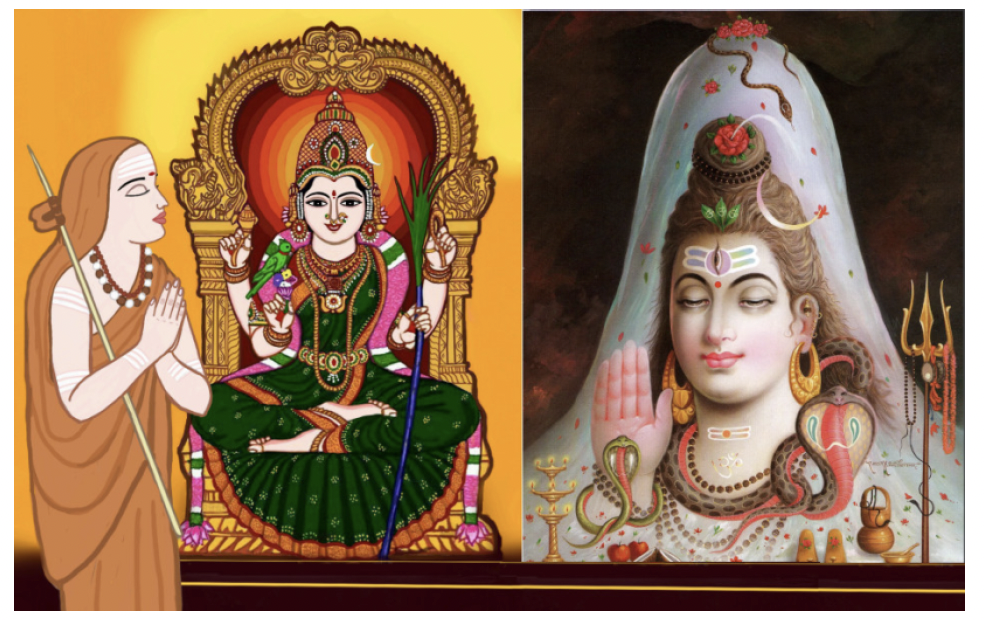
Saundaryalaharī and Śivānandalaharī are two outstanding Stotra compositions of Adi Sankaracharya, each of hundred ślokas, on Lalita Tripurasundari and Paramesvara. Both have been recommended by sages and scholars for chanting and assimilation. They are standing examples depicting स्तोत्र लक्षणम्, the characteristics of Stotra: गुणिनिष्ठगुणाभिधानं स्तोत्रम् – Stotra is devoted to the virtuous and describes the virtues; नमस्कारस्तथाशीश्च सिद्धान्तोक्तिः पराक्रमः । विभूतिः प्रार्थना चेति षड्विधं स्तोत्र लक्षणम् – Stotra has six characteristics: prostration, blessing, expounding a principle, describing valour, glory and prayer. The beautiful texts abound in sabdalankaras–alliterations and arthalankaras–metaphors, puns, and ascription (utpreksha). The texts portray the navarasas–the nine emotions that are the hallmark of great poetry.
Saundaryalaharī
Dedicated to Devi Tripurasundari, known in Śākta as Para Bhaṭṭārikā, Saundaryalaharī is a Stotra, extraordinary in all respects – in its origin, contents, melody, bhakti and Jñāna. When Adi Śaṅkarācārya had darśan of Siva and Parvati in Kailāsa, Siva blessed him with five sphaṭika lingas and a sheaf of palmleaves. Sankara established the five sphaṭika lingas in five kṣetras in Bhāratadeśa. The palmleaves contained the Stotra of Saundaryalaharī of a hundred verses, in praise of Devi, believed to have been composed by Siva himself. There are also certain other versions on the authorship of the Stotra – like Vishnu and Ganapati. Be that as it may, when Sankara was leaving Kailāsa with the palmleaf bundle in his hands, Nandi could not digest the idea of someone taking away from Kailāsa such a valuable treasure. He snatched the bundle from Sankara’s hands. The result was that Sankara was left with only the first fortyone ślokas; the balance fiftynine ślokas went to the possession of Nandi. Sankara felt disappointed. Devi said to him in a divine voice that what happened was according to her will and that Sankara should compose the balance fiftynine ślokas himself, complete the text and spread bhakti.
The first fortyone ślokas are celebrated as exposition of Mantra Sastra and known as Ānandalaharī; the following fiftynine ślokas are essentially a description of Devi from head to foot, steeped in bhakti and known as Saundaryalaharī. In fact, śloka 44 refers to वदनसौन्दर्यलहरी, the wave of beauty of Devi’s face. However, the entire text of hundred verses is presently called Saundaryalaharī. Some people believe that Sankara composed the verses in Srinagar in the Jyeshtha Rudreswara temple in Śaṅkarācārya Hill.
Composed in the beautiful ‘Śikharinī’ chandas, Saundaryalaharī gives a gist of all the three aspects of Śākta worship, viz. Mantra, Tantra and Yantra. Many are the scholarly commentaries on this text, notable of which are of Lakṣmīdhara (the most celebrated), Kaivalyasrama (Soubhagyavardhini), Kameswara Suri (Aruna Modini), Anandagiri, Tatparyadipini, Padarthachandrika, Dindima Bhashya, Gopalasundari and Ānandalaharī. Anandagiri shows that there is an esoteric Bījākṣara or connotation, hidden in every one of the hundred ślokas. Gopalasundari interestingly makes out that each śloka refers to Vishnu.
Mahaswami of Kanchi says that even after the disappearance of the physical form of Śaṅkarācārya, he blesses us through Saundaryalaharī and that all the hundred verses have the power of Mantra. The Aṣṭottara Śatanāmāvalī of Sankara mentions सौन्दर्यलहरी–मुख्य–बहुस्तोत्र–विधायकाय नमः, which establishes the pre-eminence of this Stotra. Another interesting fact is that each of the hundred ślokas has a certain yantra, certain prescribed method of Japa and offering, associated with it, which, when followed, would confer various specified mundane benefits.
Mantra is the embodiment of the energy of Devatā. In Śākta, the most celebrated of mantras is the esoteric Pañcadaśākṣarī (15 lettered) mantra, made up of bījākṣaras in three kutas (groups) – Vāgbhavakūṭa, Kāmarājakūṭa and Śaktikūṭa. This mantra has been explained in śloka 32, using the standard technique of indirectly pointing out the bījākṣaras by referring to the Devatās they represent. Sloka 33 brings out the Soubhagya Pañcadaśākṣarī mantra, which leads to Ātmananda.
Yantra is the visible medium representing mantra. In Śākta, Śrīcakra is the yantra generally worshipped. This yantra has been clearly depicted in śloka 11. Nine triangles (five of Śakti, facing downwards and four of Siva, facing upwards) result in 43 triangles when they intersect in a certain pattern. The central bindu (dot) is the 44th. These are walled in circular enclosures made up of eight lotus petals, then sixteen lotus petals, followed by three circles and, finally Bhūpuram consisting of three lines with four entrances.
Tantra is the methodology of focusing our mind on mantra and yantra, and consists of various types of Pūjās; mainly, the external Pūjā (Kaula), the internal mental Pūjā (Samaya) and Kuṇḍalinī yoga. All of these are dealt with in detail by Sankara. Sloka 31 beautifully portrays Devi’s compassion by saying that when Siva brought out 64 Tantras of external worship, which would normally yield lesser benefits, it was Devi, who persuaded him to make public the Śrīvidyā worship.
The mental Samaya Pūjā is brought out graphically in śloka 27; mere talk is Japa, all actions with hand are Mudrās, any walk is going round Devi’s shrine, food is Homam, lying down is prostration to Devi, all activities are only Pūjā, denoting complete surrender.
The six chakras of Kuṇḍalinī yoga along the spine, through which Śakti is raised to the topmost Sahasrāra chakra, where Śakti unites with Siva and showers nectar through the 72000 nāḍīs of the whole body are mentioned in śloka 9. The downward journey of Śakti back to its normal repose in Mūlādhāra chakra at the base of the spine is taken up in śloka 10. Devi’s feet in Sahasrāra chakra are beyond Time; this is explained in śloka 14, which describes the six chakras as representing the six seasons in terms of different numbers of light rays, which denote the number of days of that season. The six chakras also stand for the five elements and the mind, which pervade the entire universe (35). The special feature of worship at each of the six chakras is taken up in ślokas 36 to 41; Ājñā chakra – the form of Para Śambhu; Visuddhi – Parvati and Parameswara; Anāhata – unity of Jīva and Brahman; Svādhiṣṭhāna – Kāmeśvarī; Manipuraka – Parāśakti of the form of lightning streak among clouds; Mūlādhāra – Ananda Bhairavī with Ananda Bhairava in Tāṇḍava.
There is yet another esoteric meditation of a single bijakshara (Eam) in the form of Devi and this is called Kamakala dhyanam and is covered in śloka 19.
Though the first part of the Stotra is known as Mantra Sastra, there are ślokas therein, which describe the beauty, the compassion, the crowning glory and other characteristics of Devi, which are covered extensively in the second part. The very first śloka says that Siva, if not united with Śakti, would not be able to even move; and that accumulated merit is required to even worship Devi. Brahma, Vishnu and Siva derive their ability to perform the five functions of creation, sustenance, destruction, concealment and blessing, owing only to the grace of Devi (ślokas 2, 24).
In fact it is Devi who projects the three divinities at the start of the cycle of creation.
विभक्तत्रैवर्ण्यं व्यतिकरितलीलाञ्जनतया
विभाति त्वन्नेत्रत्रितयमिदमीशानदयिते ।
पुनः स्रष्टुं देवान् द्रुहिणहरिरुद्रानुपरतान्
रजः सत्त्वं बिभ्रत्तम इति गुणानां त्रयमिव ॥ 53 ॥
‘Beloved of Siva! These three eyes of yours shine with three distinct colours of the collyrium applied for beauty, as if bearing the three Guṇas (attributes) – Sattva, Rajas and Tamas for the purpose of reprojecting in creation the three Devas, Brahma, Vishnu and Rudra, who had been absorbed into yourself during Pralaya.’ (53)
Devi’s feet are capable of granting all the wishes of the devotee even in the absence of gestures of boon and freedom from fear, usually shown with hands (4). Her compassion is unparalleled.
भवानि त्वं दासे मयि वितर दृष्टिं सकरुणा–
मिति स्तोतुं वाञ्छन् कथयति भवानि त्वमिति यः ।
तदैव त्वं तस्मै दिशसि निजसायुज्यपदवीं
मुकुन्दब्रह्मेन्द्रस्फुटमकुटनीराजितपदाम् ॥ 22 ॥
‘One who wishes to pray to you saying ‘Bhavani! you please cast your compassionate glance upon me, a servant’, and starts with the words ‘भवानि त्वं’, ‘Bhavani! you’, at that very point (before he could complete the sentence), you grant him the state of your Sāyujya, where your feet are illuminated in the radiance of the crowns of Vishnu, Brahma and Indra’ (22). Devi’s beauty is mesmerising. Even women of Svargaloka are desirous of attaining Siva-Sāyujya so that they could enjoy that beauty along with Siva (12). Devi grants the power of divine poetry to the devotee (15, 16, 17). The devotee is even blessed with the power of ‘Gaaruda Prayoga’, the ability to nullify the effects of poisons and fever by mere look. (20). One who meditates on Devi in his own Ātma is blessed with the highest dispassion and Jñāna (30).
There is an interesting prayer that the black tresses of Devi should remove the internal darkness of the devotee (43). The description of Devi’s forehead is highly imaginative. It is like crescent moon and, if joined with the crescent on the head after reversing them, it gives rise to full moon, exuding nectar (46). The eyelashes remind the poet of Manmatha’s bow (47). The description of the beauty of the three eyes is highly imaginative and is covered in a number of verses. The eyes at once emit eight ‘rasas’, which include compassion (51). The eyes resemble Sona river in red, Yamuna in dark and Ganga in white and purify the devotee (54). The power of Devi’s ear-studs (indicative of chastity) is such that Siva survives even after consuming the terrible Halahala poison (28). The sweetness of Devi’s voice overpowers that of Sarasvatī’s vina (66). Devi’s feet are borne by Upaniṣads on their head (84). There is a prayer that the devotee’s mind and the five sense-organs should become a six-legged bee at the lotus feet of Devi (90). Devi’s couch is supported on the four legs, viz. Brahma, Vishnu, Rudra and Īśvara and has the seat-spread of Sadāśiva (92).
Sankara concludes the Stotra on a striking note of extreme humility (100).
Śivānandalaharī
Śivānandalaharī is believed to have been composed by Adi Sankara while he was camping in Śrīśailam, a pilgrimage town in Andhra Pradesh and dedicated to Shri Mallikārjuneśvara and Devi Bhramarāmbikā in the temple there (Slokas 50 and 51 point to this clearly). Siva is the form of bliss. In Sivanandalahari, we immerse ourselves in the continuous waves of bliss of Siva. In Sloka 3, the Acharya explains that the wave is born in the river of Siva’s stories, it cleanses us of the dirt of sin, travels in the manifold tracks of the mind, eliminates samsara and stays for ever in the pond of our mind. The ślokas in this text are set to various metres such as Śikharinī, Śārdūlavikrīḍita, Vasantatilakā etc.
Bhakti is the primary teaching of this text. The many modes of bhakti, the ways of controlling the fickle mind, focusing on Siva and surrendering the mind completely to Siva, the various types of prayers, varied references to great devotees’ lives are all sure to captivate our attention and guide us on the path of bhakti. Emphasis is laid on the necessity of humility and submission. The many lilas of Siva – Tripurasaṃhāra, Jyotistambha Darshan, consumption of Halahala poison, Tāṇḍava Nṛtya etc. – are often brought up for the devotee to fix his mind on the glory of Siva. Devotees of Siva including Brahma, Vishnu, Arjuna, Kannappa Nayanar and Saakya Nayanar have been extolled as shining examples of bhakti. How to pray for Siva’s compassion is taught in different ways.
Adi Sankara gives us the celebrated definition of bhakti in śloka 61.
अङ्कोलं निजबीजसन्ततिरयस्कान्तोपलं सूचिका
साध्वी नैजविभुं लता क्षितिरुहं सिन्धुः सरिद्वल्लभम् ।
प्राप्नोतीह यथा तथा पशुपतेः पादारविन्दद्वयं
चेतोवृत्तिरुपेत्य तिष्ठति सदा सा भक्तिरित्युच्यते ॥६१॥
“Just as the scattered seeds of the Ankola tree attach themselves to the (parent) tree, the iron needle clings to the magnet, the chaste woman loves her own beloved, the creeper seeks the tree for support, the river merges with the ocean, in the same way, when the mode of the mind reaches the twin lotus feet of Paśupati and always sits there, that is called bhakti.”
Śivānandalaharī is invaluable to the sādhaka as it focuses on teachings to the mind that is at the root cause of all troubles and yet, when transcended, yields the ultimate bliss. The mind is the necessary ladder to the climb to the roof of the mansion of Mokṣa, and it is bhakti that purifies and prepares this mind. Adi Sankara uses several analogies for the mind, which, when left uncontrolled and sullied by attachments, is like a monkey (20), a thief (22), a forest of wild animals (43), a box of foul odour (74), the hard ground (64, 79, 80, 95), and an intoxicated elephant (96, 97).
For a mind that has been trained to turn itself away from mundane attractions and to be established in Siva’s worship, Adi Sankara offers comparisons with the pot of purificatory water (36), a pure tent for Siva to reside in (21), the sky for the moon of Siva to rise in (38), the city for King Siva to rule in (39), the field (for the sowing) of bhakti (40), a fort for Siva to reside in (42), the cave of residence of Panchamukha Isvara (44), a chataka bird awaiting the rain from the cloud of Siva (52), a gem-studded sandal for Siva’s use (64), a thoroughbred horse for Siva to ride on (75), a chaste woman (77), and the best maiden (78, 84). Sankara assures: “What is there to fear when the water of Siva’s stories unites with the crop of devotion in the field of the heart (40) and when the lion of Siva lives in the den of the mind (44).”
With verses that paint visual pictures and offer clear examples to the human mind, Adi Sankara teaches us how intensely to seek the feet of Siva. “Just as the swan intensely desires to be in the lotus pond, the chataka bird desires the dark clouds, the chakravaha bird desires the sun, the chakora bird desires the moon, similarly Paśupati, Omnipresent One, Lord of Gouri, my mind desires your twin lotus feet which are sought by those who are on the path of Jñāna, for the feet give me assurance of the eternal bliss of Mokṣa (59).”
In Sūtra 82 of the Nārada Bhakti Sūtras, Nārada states that bhakti is one, but it can be expressed in eleven different modes. It is noteworthy that all these eleven forms have been expressed in Śivānandalaharī – “Love for extolling the virtues of Bhagavān 1, meditating on the form of Bhagavān 2, worshipping Bhagavān 3, constantly reflecting on Bhagavān 4, serving Bhagavān 5, friendship with Bhagavān 6, love for Bhagavān as one’s own child 7, as one’s beloved 8, love for complete surrender to Bhagavān 9, complete absorption in Bhagavān 10, love expressed as intense pangs of separation 11.”
Bhakti itself has been described with various metaphors such as a group of women (46) that lives in the mansion of the feet of Śiva, the creeper (49) at the feet of Śiva yielding the fruit of liberation, a caring mother (62) who nurtures the devotee, a cow (68) that lives in the cow pen of the feet of Śiva and yields unlimited nectar of joy, the mass of rain-bearing clouds (76) that reside in the sky of the feet of Śiva, filling the pond of the mind. In this context, Śankara teaches us that the sentiment of love and humility is more important than any materials offered by the devotee 12.
Bhakti, in definition, may not be the same as Mukti, since there is still duality in bhakti, and oneness or non-duality (Advaita) is yet to be attained. However, Śankara says that the four grades of Mokṣa described in Śāstras are attainable through bhakti (28) — Pūjā leads to Sārūpyam, Nāmasankīrtanam to Sāmīpyam, Śivabhaktasangam to Sālokyam, and looking at the world as pervaded by Śiva to Sāyujyam (this reminds us of Śrī Rudram).
Śaṅkara has defined the jīvanmukta, the one who is liberated whilst living (81):
कञ्चित्कालमुमामहेश भवतः पादारविन्दार्चनैः
कञ्चिद्ध्यानसमाधिभिश्च नतिभिः कञ्चित्कथाकर्णनैः ।
कञ्चित् कञ्चिदवेक्षणैश्च नुतिभिः कञ्चिद्दशामीदृशीं
यः प्राप्नोति मुदा त्वदर्पितमना जीवन् स मुक्तः खलु ॥८१॥
“Umāmaheśvara! One who spends time, worshipping your lotus feet, practicing dhyāna and samādhi, prostrating to you, listening to your stories, having darśan of your form, chanting your hymns and stays in such kind of states, with great happiness, with his mind dedicated to you, he alone, indeed, is a jīvanmukta.” Śankara thus shows how one can become a jīvanmukta through the path of bhakti. Further, he says: “The creeper of devotion yields the fruit of liberation (49)”; “Those who churn the ocean of Vedas with the rod of the diligent mind and the rope of firm bhakti obtain the nectar of eternal bliss and the perpetual fortune of Mokṣa (37)”; “By using the bowstring of intense devotion, the bow of single-pointed attention, the arrows of meditation, the victorious bhakta with great bliss gains the permanent kingdom of Mokṣa (71)”. He further asserts that bhakti is not a means of attaining Mukti, but bhakti is itself Mukti 13.
With verses such as 53 and 93, Adi Sankara establishes that there is no contradiction between his works on bhakti, such as Śivānandalaharī, and his works of Advaita Vedānta. The Siva that we worship is the blue-necked Nilakantha (peacock) that sports in the garden of Vedānta – वेदान्तोपवने विहाररसिकं तं नीलकण्ठं भजे (53). The Siva that we meditate upon is the mahamahas (the great light) – महामहसि । स्वामिनि गिरिजानाथे मामकहृदयं निरन्तरं रमताम् (93). By merging in the great light of Siva, we become one with the ultimate. This is the essence of Advaita Vedānta.
 References:
- Slokas 2, 18, 31, 32, 34, 38, 44, 50, 51, 55, 56, 70, 92, 100 – Śivānandalaharī
- Slokas 3, 87, 93 – ibid
- Slokas 1, 4, 6, 17, 23, 29, 36, 39, 53, 54, 72, 73, 83, 89, 90 – ibid
- Slokas 7, 10, 12, 23, 35, 46, 52, 59, 64, 65, 74, 75, 76, 79, 80, 94, 95, 96, 97 – ibid
- Slokas 20, 21, 22, 24, 25, 26, 27, 30, 40, 42, 43, 63, 68, 69, 82 – ibid
- Sloka 14 – ibid
- Sloka 62 – ibid
- Slokas 61, 78, 84, 98 – ibid
- Slokas 5, 8, 9, 11, 13, 14, 15, 16, 19, 41, 57, 58, 60, 61, 66, 85, 86, 88 – ibid
- Slokas 28, 33, 37, 45, 47, 48, 49, 67, 71, 81, 91, 99 – ibid
- Sloka 77 – ibid
- Slokas 63, 85, 86 – ibid
- Slokas 33, 73 – ibid
(Source: Souvenir, Fifth Kumbhabhishekam, Sankara Mattham, Matunga, Mumbai, April 2026)